
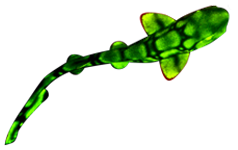
Fluorescence for Education and Outreach
“Now I can use fluorescence in my classes!”
We heard this over and over as soon as we introduced our Model SFA Stereo Microscope Fluorescence Adapter to the scientific community, and the message continues to resonate. Not only can it handle routine research tasks like sorting, screening, and dissection, but the price point and simplicity make it practical to add it to lab class stereo microscopes. Prior to the SFA the cost (easily $20,000 and up) and complexity of conventional fluorescence stereo microscopes from the major manufacturers were virtually insurmountable barriers to incorporating fluorescence in routine undergraduate laboratory courses. Those systems are terrific for research, but you can’t buy lots of them and you are not going to turn a group of inexperienced undergraduates loose on them. At under $1,100 per unit, simple to use, and rugged enough to stand up to repeated student handling, the NIGHTSEA SFA breaks through the cost and complexity barriers (and there is a discount for orders of 10 or more).
“The relatively low cost enabled us to purchase enough for our students, and they allow us to have students make observations of specimens that they would otherwise not be able to study.”
There are many disciplines – biology, marine science, forensic science, materials evaluation, and more – in which fluorescence is a key means to see what you need to see at the level of the stereo microscope. However, without a practical way to visualize fluorescence you can’t take advantage of this.
“Due to their affordability, we were able to purchase 6 units for our developmental biology teaching lab! A great investment!”
The SFA is a near-universal modular system that attaches to the stereo microscopes that you already own at a price that can be 5% or less of the cost of a ‘conventional’ fluorescence stereo microscope. All you need is one excitation/emission wavelength combination to get started, with the option to add additional wavelength sets (we offer 5 options) at about half the cost of the original system.
The benefit is not just in the initial cost. The SFA attaches in seconds and is extremely rugged so students get a true hands-on experience.
“Our students were very excited to use them and they did not require any special training as the units adapt easily to the stereoscopes that we presently own and are very user friendly.”
“Since the SFA is simple to use my students have complete freedom to handle it, something that they are unable to do with the more high end microscopes.”
-
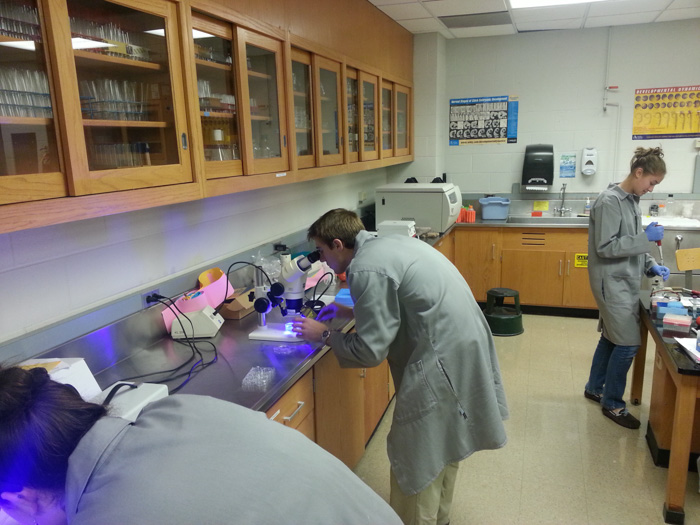
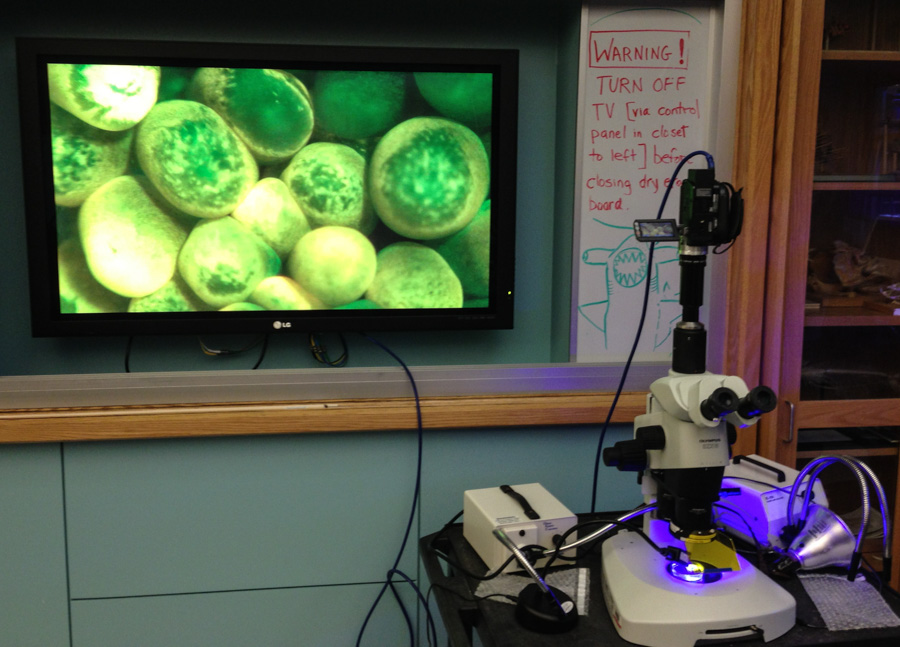
- SFA in a biology teaching lab
-
- SFA with microscope/camera for teaching
-
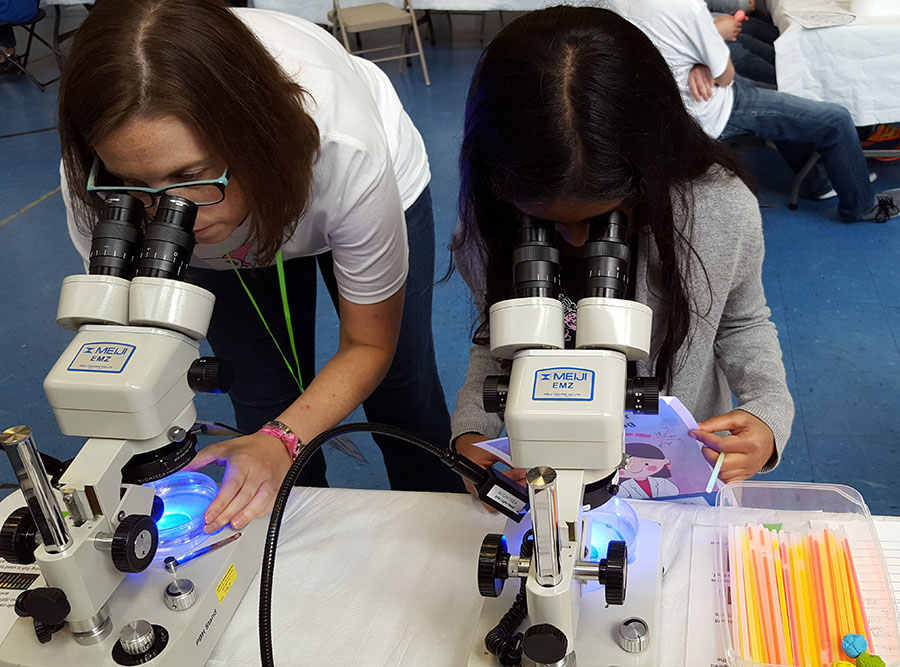
- Observing fluorescent zebrafish under the microscope at BrainFest
Lab module publications and case studies
Several publications describe lab modules that use the NIGHTSEA SFA for viewing fluorescence, and there are numerous other examples.
- A 2017 paper in the Journal of Microbiology & Biology Education describes the use of the SFA in a laboratory sequence that enables students to explore the effect that random mutagenesis can have on protein function, expression, and ultimately phenotype. This is part of an undergraduate Genetics course (300-level course for sophomore, junior, and senior biology, biochemistry, and marine biology majors). See our article for more information.
- Cole, J., Ferguson, A., Segarra, V. A., & Walsh, S. (2017). Rolling Circle Mutagenesis of GST-mCherry to Understand Mutation, Gene Expression, and Regulation. Journal of Microbiology & Biology Education, 18(1). doi:10.1128/jmbe.v18i1.1201. Link to article
- A 2019 paper in Biochemistry and Molecular Biology Education describes the use of the SFA in a lab experience that allows students to be actively engaged in the full process of design, implementation of a gene editing strategy, and interpretation of results within an 8-week lab period of a Genetics course. The lab module combines two transformative biotechnology tools; the use of GFP as a diagnostic marker of gene expression and the fundamentals and specificity of CRISPR-cas9 to editing genes in bacterial cells.
- Pieczynski, J. N., Deets, A., McDuffee, A., & Lynn Kee, H. (2019) An undergraduate laboratory experience using CRISPR‐Cas9 technology to deactivate green fluorescent protein expression in Escherichia coli. Biochemistry and Molecular Biology Education. doi: 10.1002/bmb.21206. Link
- There are numerous other, non-published, examples of the SFA being used in lab classes. We have compiled a document summarizing some of these. Click to download.
Outreach
The SFA is also great for outreach.
- Through the Student Scientists Outreach Program that he developed, Dr. Michael Barresi of Smith College is promoting STEM education in primary and secondary schools using zebrafish as the model organism. He uses the NIGHTSEA SFA adapter to visualize fluorescence in the classroom.

- From 2012 – 2016 the University of Montana’s Center for Structural and Functional Neuroscience (CSFN) operated the BrainZone at the spectrUM Discovery Area, a hands-on science center in downtown Missoula, Montana, that inspires young Montanans to pursue higher education and possibly STEM careers. They used the SFA along with the BlueStar and DFP-1 flashlights to reveal the wonder of fluorescence over a range of scales. In addition to the displays at the Discover Area, the team took the SFA on the road as part of their broader outreach. Links:
- Article on this web site
- Big Sky Brain Project
- Events blog – several of the photos show the SFA in use, even outdoors, to show fluorescence
- Glowing Cells lesson plan
- Dr. Jenny Lenkoswki of Goucher College uses her SFA both for research and for STEM outreach. Read her guest post about showing zebrafish fluorescence at BrainFest – a day of science education for the Baltimore community focusing on neuroscience.
- Dr. Scott Weatherbee of Yale University contributed a guest post on using the SFA in the “Pathways to Science” STEM outreach program that provides educational opportunities for New Haven Public School students.
Comments from people using the system in their teaching laboratories:
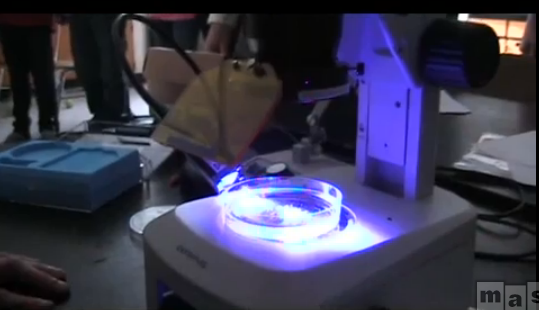
“Students in Developmental Biology Lab were examining the effects of pharmacological agents on development of zebrafish embryos. In order to better visualize the development of the nervous system and vasculature, we used transgenic fish that expressed GFP either throughout their nervous system or in the developing vasculature. The NIGHTSEA system easily adapted to our dissection scopes and allowed students to observe the development of their fish at several different time-points. They could readily observe the transgene expression, and it helped solidify the phenotypes they were observing and allowed them to determine an optimal time to fix their fish for analysis under the compound microscope.” – Jason Meyers, Colgate University
“We purchased a number of the GFP adapters for use in our undergraduate teaching labs. They have been great – much brighter and easier to use than our old “homemade” system. Our students are now able to observe GFP in C. elegans and zebrafish and take pictures using digital cameras that we mount on the eyepiece. It’s been great having them available – the relatively low cost enabled us to purchase enough for our students, and they allow us to have students make observations of specimens that they would otherwise not be able to study.” – Casey Roehrig, Harvard University
“I would definitely recommend this product to anyone looking for reasonably priced, portable, fluorescence for your stereoscope. Our students were very excited to use them and they did not require any special training as the units adapt easily to the stereoscopes that we presently own and are very user friendly. Due to their affordability, we were able to purchase 6 units for our developmental biology teaching lab! A great investment!” – Katherine Patenaude, Brown University
“We ordered two NIGHTSEA Stereo Microscope Fluorescence Adapters to use in my graduate level genetics laboratory course at Boston University. We used these setups to examine an Arabidopsis thaliana population segregating a GFP reporter for a root expressed gene. … The students found the setup very easy to use. Because of the success with the usage of the NIGHTSEA Stereo Microscope Fluorescence Adapters this year, next year I am going to develop additional lab modules using GFP reporters in Arabidopsis.” – John Celenza, Boston University