
Entomology
NIGHTSEA fluorescence solutions can have a variety of uses in entomology, from the laboratory to the field, and over a wide range of scales. Whether working with transgenic specimens, more easily observing taxonomic features, locating insects in the field, adding markers to be able to follow movement, there are diverse ways to apply fluorescence in this discipline. Not to mention that images of fluorescent insects can just be beautiful.
(Click image for larger view)
-
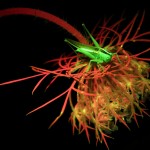
- Grasshopper on Queen Anne’s lace fluorescence – (c) Charles Mazel

-
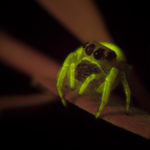
- Spider fluorescence – (c) DanJones

-
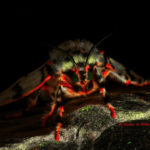
- Rosy gypsy moth (Lymantria mathura) fluorescence – (c) Shawn Miller

-
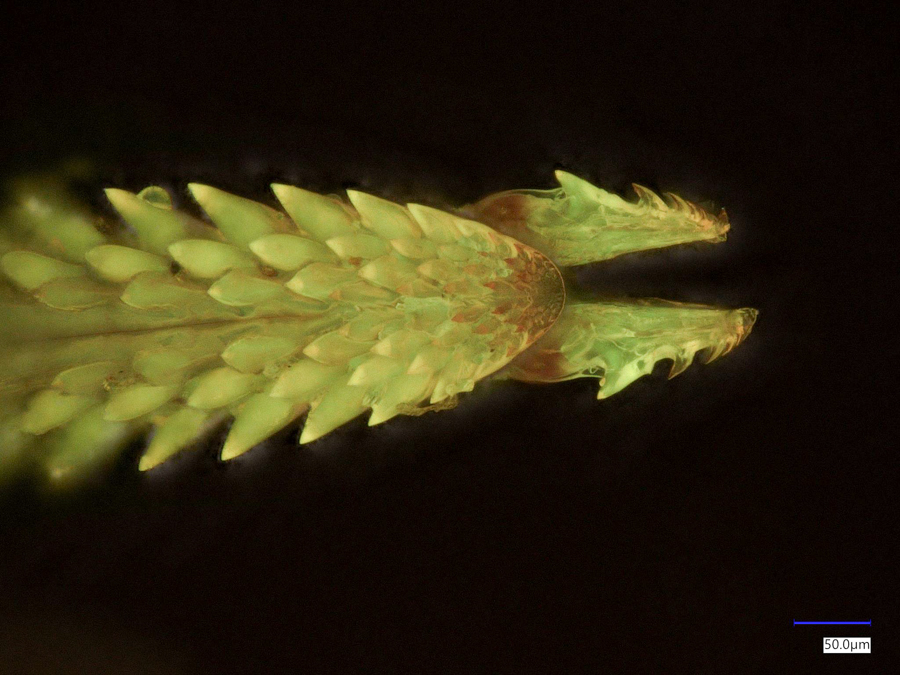
- Natural fluorescence of the business end of a tick, RB excitation, 500x Keyence VH-Z500 lens
Insect-related articles and galleries on this site
- Pest management behavior study with fluorescent marking
- Exploring for insect fluorescence in the wild
- Insect fluorescence images from Australia
- Insect fluorescence images from Okinawa
- Grasshopper fluorescence
- Caterpillar fluorescence
Some references to published work that has used NIGHTSEA equipment with insects:
- fluorescence excited by blue light to find specimens in the lab or field
- Woller, D. A., Foquet, B., Kilpatrick, S. K., Selking, R., Mazel, C., & Song, H. (2020). UNLOCKING THE DARK: Harnessing Blue-Light Fluorescence to Illuminate Hidden Hexapods. American Entomologist, 66(1), 38-47. Open access
- DiFonzo, C. D. (2022). Western bean cutworm (Lepidoptera: Noctuidae) feeding and development on industrial hemp in the laboratory and field. The Great Lakes Entomologist, 55(1), 4. Open access
- tracking via fluorescent tags
- Hagler, J. R., Casey, M. T., Hull, A. M., & Machtley, S. A. (2022) Liquid fluorophore taggants for mark‐release‐recapture research: a survey of potential arthropod targets. Entomologia Experimentalis et Applicata.
- Akter, H., Taylor, P. W., & Crisp, P. (2020). Visibility and Persistence of Fluorescent Dyes, and Impacts on Emergence, Quality, and Survival of Sterile Queensland Fruit Fly Bactrocera tryoni (Diptera: Tephritidae). Journal of Economic Entomology, 113(6), 2800-2807.
- observing fluorescent-tagged pyriproxyfen to monitor for transfer
- Kancharlapalli, S. J., Surowiec, K., Longing, S. D., & Brelsfoard, C. L. (2022). NECTAR SOURCE AND POLLINATOR CROSS CONTAMINATION AND PERSISTENCE OF PYRIPROXYFEN ASSOCIATED WITH THE USE OF AUTODISSEMINATION TECHNIQUES FOR MOSQUITO CONTROL. Journal of the American Mosquito Control Association.
- Kancharlapalli, S. J., Crabtree, C. J., Surowiec, K., Longing, S. D., & L. Brelsfoard, C. (2021). Indirect transfer of pyriproxyfen to European honeybees via an autodissemination approach. PLOS Neglected Tropical Diseases, 15(10), e0009824.
- tracking annual bluegrass weevil vertical movement with fluorescent markings and photography
- Czyzewski, B. D., & McGraw, B. A. (2018). Detection of Listronotus maculicollis (Coleoptera: Curculionidae) Turfgrass Canopy Activity With the Use of a Novel Fluorescent Marking System Suggests Opportunities for Improved Mechanical Control. Environmental Entomology, 47(6), 1525-1531.
- microplastics-related research
- Ritchie, M. W., Provencher, J., Allison, J. E., Muzzatti, M. J., & MacMillan, H. A. (2023). The digestive system of a cricket pulverizes polyethylene microplastics. bioRxiv, 2023-05.
- Helmberger, M. S., & Grieshop, M. J. (2022). Characterizing Fragmentation of Polystyrene Foam Debris by Isopods Oniscus asellus (Isopoda: Oniscidae) and Trachelipus rathkii (Isopoda: Trachelipodidae). Environmental Entomology, 51(4), 710-715.
- fluorescence under the microscope enhances the ability to distinguish taxonomically relevant features
- Shade, D. A. (2018). Morphological observations of fluorescence in different tick species (Family: Ixodidae). Acarologia, 58(4), 989-994. Open access
- Wilcox, A. (2021). A Description and Examination of Fluorescence in Nine North American Firefly Species (Coleoptera: Lampyridae). Psyche: A Journal of Entomology, 2021.
- fluorescence used to screen transgenic soybean roots
- Lin, J., Wang, D., Chen, X., Köllner, T.G., Mazarei, M., Guo, H., Pantalone, V.R., Arelli, P., Stewart, C.N., Wang, N. and Chen, F., (2016). An (E, E)‐α‐farnesene synthase gene of soybean has a role in defense against nematodes and is involved in synthesizing insect‐induced volatiles. Plant Biotechnology Journal, 15(4), 510-519.
- fluorescence microscopy used to select transgenic moth pupae
- Zhou, L., Alphey, N., Walker, A. S., Travers, L. M., Hasan, F., Morrison, N. I., … & Raymond, B. (2018). Combining the high‐dose/refuge strategy and self‐limiting transgenic insects in resistance management—A test in experimental mesocosms. Evolutionary Applications, 11(5), 727-738.
- Somerville, J., Zhou, L., & Raymond, B. (2019). Aseptic Rearing and Infection with Gut Bacteria Improve the Fitness of Transgenic Diamondback Moth, Plutella xylostella. Insects, 10(4), 89.
- fluorescence microscopy in gene editing of the fall armyworm
- Chen, X., & Palli, S. R. (2022). Development of multiple transgenic CRISPR/Cas9 methods for genome editing in the fall armyworm, Spodoptera frugiperda. Journal of Pest Science, 1-14.
Browse the products and resources on this web site, and contact NIGHTSEA if you have questions about your entomology-related applications.

Related Articles
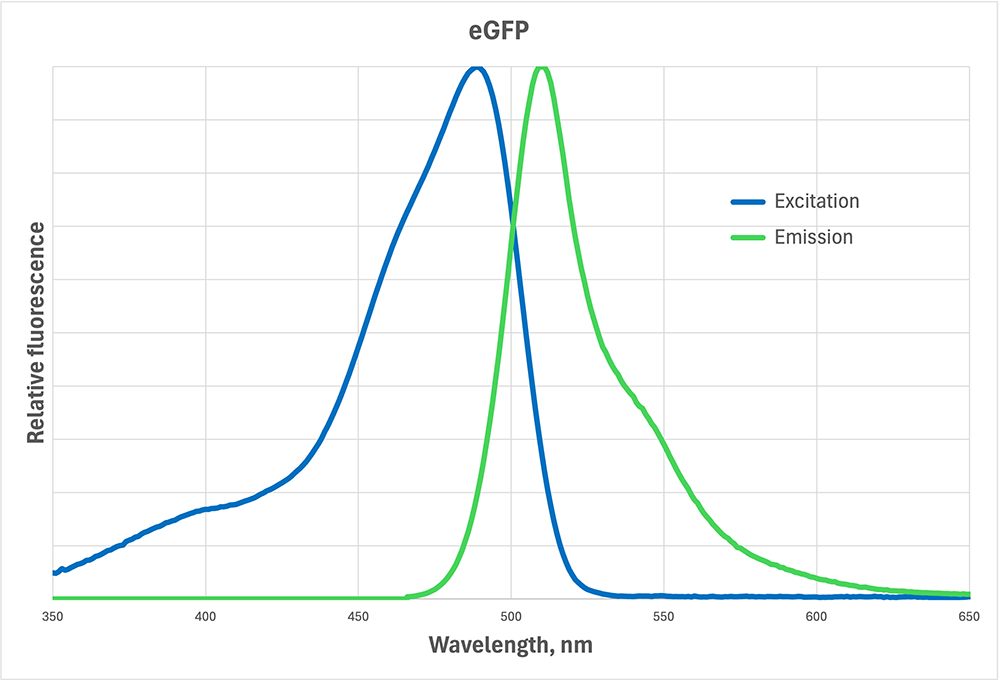
Fluorescence Excitation and Emission – Maxima vs Spectra
This article describes the relationship between fluorescence spectra vs maxima, and their role in selecting appropriate excitation and emission wavelengths.
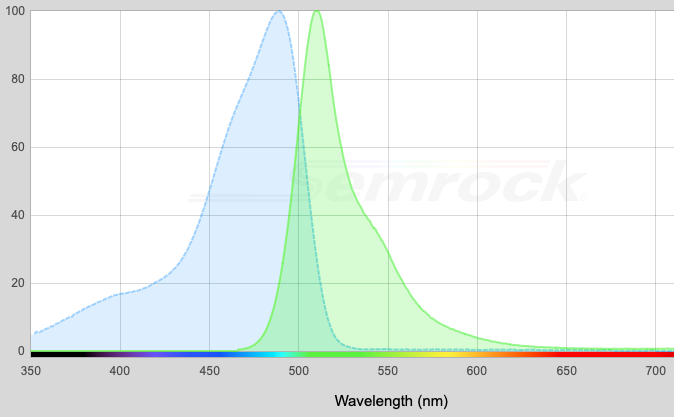
Why NIGHTSEA Offers Different Excitation Wavelengths
Why do we offer different color light sources? You need multiple options for excitation wavelengths because different materials may need different wavelengths to cause them to fluoresce.

Signal from Noise – A Cautionary Fluorescence Tale
It is important to understand the impact that the choice of barrier filters can have on your fluorescence images. You may even think you are seeing something that is not there.
Related Posts

KEY Award Recipient – 2023
Dr. Andrea Suria is the recipient of the 9th Annual KEY Award for New Faculty.
2023 KEY Award for New Faculty
Fluorescence microscopy – KEY Award for New Faculty
KEY Award Recipient – 2022
We are pleased to announce that Dr. Oscar Ruiz of Houston Christian University is the recipient of the 8th annual NIGHTSEA/EMS KEY Award for New Faculty.
2022 KEY Award for New Faculty
The application period for the 2022 KEY Award for New Faculty is open!