

KEY Award Recipient – 2022
Posted On: Thursday, October 20, 2022
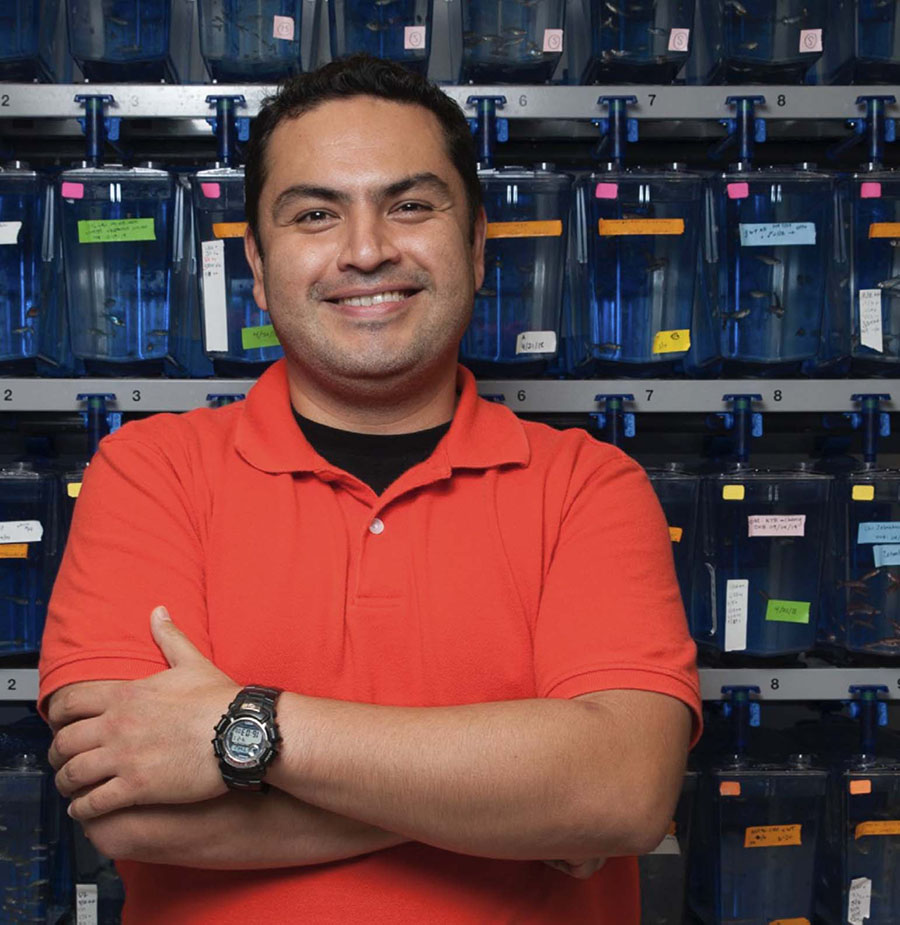
The recipient of the 2022 NIGHTSEA/EMS KEY Award for New Faculty is Dr. Oscar Ruiz, Assistant Professor of Biology in the College of Science and Engineering at Houston Christian University. The KEY Award was instituted in 2015 by NIGHTSEA founder Dr. Charles Mazel to acknowledge his own mentors and as a way of giving back to the scientific community. The annual award includes a NIGHTSEA Model SFA Stereo Microscope Fluorescence Adapter system outfitted with two excitation/emission combinations plus $750 in supplies from the Electron Microscopy Sciences (EMS) catalog.
Dr. Ruiz received his PhD from the Univ. of Utah, working in the lab of Dr. Mark Metzstein on the development of the larval Drosophila respiratory system. After his graduate work Oscar pursued his interest in host-pathogen interactions by moving to Lisbon, Portugal, for postdoctoral work in the laboratory of Dr. Luis Teixiera. There, he largely focused on host-microbe interactions in Drosophila and specifically on the identification of genes that are important for its immunity to viruses. Oscar then moved to Texas to work at MD Anderson Cancer Center in the laboratory of Dr. George Eisenhoffer, where his research focused on studying tissue homeostasis in epithelia and the opportunistic infections that can arise when epithelia are damaged.
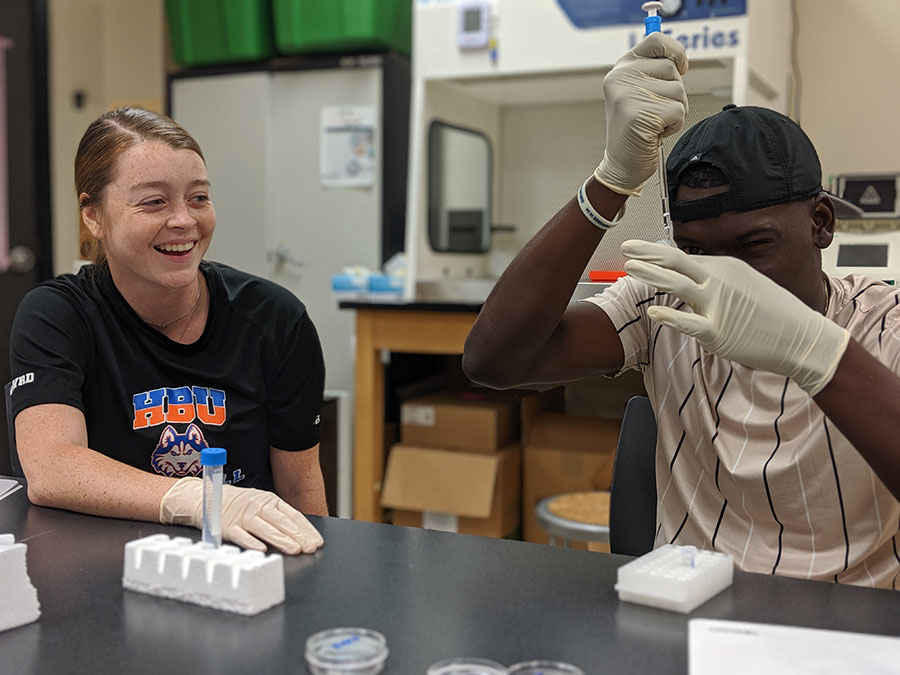
Dr. Ruiz’s current research involves fluorescent labeling of the zebrafish epithelium to conduct live-imaging experiments aimed at identifying the molecular function of the genes involved in both normal and damaged epithelial development and their respective contributions to pathogenic infections. He works with a transgenic line of zebrafish that only expresses GFP in the presence of active viral infections. The NIGHTSEA SFA will enable students to quickly assay for the presence or absence of viral infections in CRISPR-genome edited fish exposed to viral particles. This will allow them to establish a high-throughput screening platform to quickly identify important genes involved in epithelial maintenance and viral infections.
Dr. Ruiz is also committed to training and diversifying the next generation of scientists. He regularly participates in the national SACNAS and ABRMCS meetings as a presenter, poster judge, and mentor. He has prepared a series of hands-on activities for elementary school students using fluorescent zebrafish embryos and fruit flies to highlight the use of model organisms to study human health, and will use the NIGHTSEA system to support that activity.
(Click image for larger view)
Past recipients
- 2021 – Dr. Kyle Gustafson (Arkansas State University)
- 2020 – Dr. Heather Ray (Idaho State University)
- 2019 – Dr. Josh Currie (University of Toronto)
- 2018 – Dr. Pierre-Paul Bitton (Memorial University of Newfoundland)
- 2017 – Dr. Kristen Gorman (California State University Chico)
- 2016 – Dr. Sarah Petersen (Kenyon College)
- 2015 – Dr. Robert Mitchell (University of Wisconsin Oshkosh)