
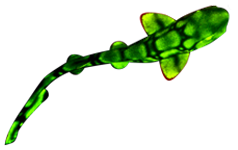
Corals and Fluorescence at Coral Morphologic
Visit to fluorescence explorers Coral Morphologic in Miami.
read more »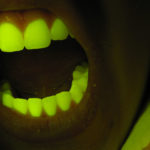
Fluorescence and Visual Function
It is tempting to think that the fluorescence of animals is there to serve a visual function, but it is more likely that in most cases it is just an incidental phenomenon. There is a lot of hard science to do to demonstrate that the fluorescence is serving a purpose.
read more »
Fluorescence and ‘Rarity’
A species is ‘rare’ in a habitat if you can find fewer of them than you can of similar organisms. Sometimes you are limited by your ability to search, and fluorescence can be a powerful tool to find otherwise hard-to-find specimens.
read more »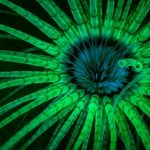
Fluorescence Image Takes 1st Place National Geographic 2017 Nature Photographer of the Year in Underwater Category
Congratulations to Jim Obester for his 1st place victory in National Geographic’s “Nature Photographer of the Year Contest” with his striking image of a tube-dwelling anemone (Cerianthus sp.).
read more »Why You Might Want Fluorescence Dimming
Why would you want fluorescence dimming? In general you want as much fluorescence as you can get! Many naturally fluorescent subjects do not glow very brightly, and the fluorescent proteins and stains used in the life sciences can range from dim to bright but tend to be localized in small areas. The more fluoresced […]
read more »
iBiology as a Resource for Fluorescence Techniques and More
iBiology.org is a fantastic free resource for educational videos, featuring an incredibly wide array of biological themes, principles, research topics, and ideas
read more »
White Balance for Fluorescence Photography
A discussion of white balance selection for fluorescence photography
read more »LED Dimming Using the PULSE Option and PWM
With the PULSE option for the SFA base you can use an external controller (computer, function generator, etc.) to turn the LED on and off at full intensity with precise timing. In addition you can use PWM (pulse width modulation) as a dimmer control. With PWM you input a square wave signal at a […]
read more »
Fluorescence Reveals Hard-To-Find Marine Life
You can’t study what you can’t see – read how researchers used fluorescence as a tool to find cryptic fish species and juvenile corals
read more »Genetics Laboratory Experiment
We try to keep track of publications that cite use of NIGHTSEA equipment. These are mostly research-oriented papers, but we were excited to find a paper in the Journal of Microbiology and Biology Education that describes a laboratory sequence for a sophomore-and-above Genetics course at Rollins College. (Citation and links at the end of […]
read more »
The Case of the Fluorescent Fibers
We investigated the source of individual, brightly fluorescing fibers found on ordinary towels and washcloths.
read more »Marine Fluorescence Imaging at the Monterey Bay Aquarium
From NIGHTSEA founder Charles Mazel In August 2017 I was in Monterey, CA, on vacation and of course visited the wonderful Monterey Bay Aquarium. While there I connected with Jim Covel, Director of Guest Experience, Training, and Interpretation. After a brief conversation about fluorescence of marine organisms Jim invited me to return later that day […]
read more »
Screening FISH-Labeled Planarian (Schmidtea mediterranea)
Screen planaria (SMED – Schmidtea mediterranea) FISH-labeled samples for successful preparation with the NIGHTSEA Model SFA Stereo Microscope Fluorescence Adapter prior to moving to higher resolution imaging techniques.
read more »Mineral Fluorescence Under Blue Light
The geology community knows a lot about mineral fluorescence under excitation by various wavelengths of ultraviolet light but when it comes to excitation by light in the visible portion of the spectrum, such as blue, … not so much.
read more »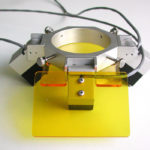
Origin of the Model SFA Stereo Microscope Fluorescence Adapter
Did you ever wonder how a new piece of equipment comes into existence? The Model SFA arose from a solution to our own marine biology research challenge.
read more »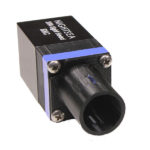
Light Restricting ‘Snoot’ for the SFA
In photography, a snoot is a tube or similar object that fits over a studio light or portable flash and allows the photographer to control the direction and radius of the light beam. We have created a snoot for the excitation light sources for our Model SFA Stereo Microscope Fluorescence Adapter. While the beam from […]
read more »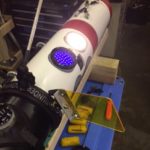
Fluorescence Excitation Filters with Custom Holders for an Underwater Vehicle
I (NIGHTSEA founder Dr. Charles Mazel) was contacted by an old friend to provide fluorescence excitation filters for the LED lights on a new underwater exploration vehicle. Michael Lombardi is the creator of Oceans of Opportunity, of which Lombardi Undersea is a part. I got to know Mike during a large-scale research program on underwater optics being conducted […]
read more »940nm Light Head
Dr. Daryl Hurd uses the model organism C. elegans for varied research in genetic controls of behavior and sensory and motor function. He had been happily using the NIGHTSEA Model SFA Stereo Microscope Fluorescence Adapter GFP- and RFP-tagged specimens and contacted us with a new challenge: “My laboratory is interested in using C. elegans to study photobiostimulation, […]
read more »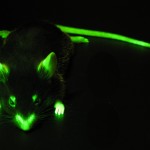
‘Glow-in-the-Dark’ vs Fluorescent
Popular articles often call things ‘glow in the dark’ that really aren’t. They are actually fluorescent, and that is a wonderful thing. Read this to understand the difference.
read more »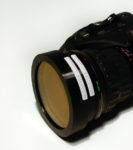
Custom Adapter for Fluorescence Video
Creating custom lens and filter holders for a fluorescence video project.
read more »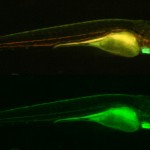
Longpass vs Bandpass Barrier Filter for Green Fluorescence
Trade-offs between the longpass and bandpass (green-only) filters for use with the Royal Blue excitation.
read more »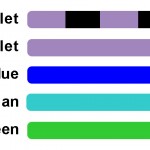
Naming and Color Coding the NIGHTSEA Wavelength Combinations
The light source and matching filters for the NIGHTSEA Stereo Microscope Fluorescence Adapter are color coded for easy application.
read more »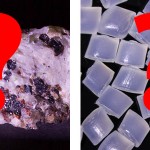
Empirical vs Scientific/First Principles Exploration of Fluorescence
There are two types of approaches to answering the question of whether something fluoresces – empirical (try it and see) vs scientific (make careful measurements). Read to learn the difference.
read more »Fluorescence Appearance can Depend on Excitation Wavelength
With fluorescence, what you see depends on how you excite and view the subject – the interaction of the excitation wavelength, the fluorescing substance, and the barrier filter.
read more »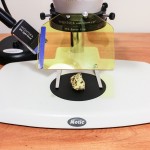
Stereo Microscope Filter Shield
Fluorescence stereo microscopes should include a protective shield. The NIGHTSEA filter shield does double duty as an eye protector and as a viewing filter.
read more »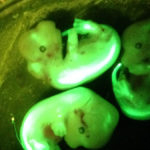
Selecting and Dissecting GFP Mouse Embryos
Implementing fluorescence in a mouse facility to enhance selection and detection.
read more »Checking Fluorescence of Bacterial or Cell Cultures
NIGHTSEA flashlights and microscope adapters can be used with fluorescent bacterial or cell cultures.
read more »
Insect Fluorescence in the Wild
A fun evening jaunt to search for fluorescing insects in Ocala National Forest, Florida.
read more »Fluorescent Life in Seaweed
On a recent trip to Cape Cod I grabbed a random sample of seaweed floating by the shore in Quisset Harbor. Just enough to not overfill a plastic take-out food container. I took it back to my stereo microscope fitted with our fluorescence adapter. Wow! The diversity of life was phenomenal for this tiny little slice […]
read more »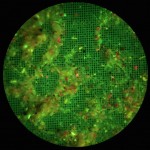
Defect Detection in Nylon Granules
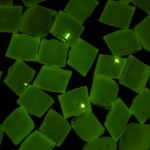
The problem NIGHTSEA was approached by a manufacturer of plastic granules, specifically nylon 6,6. These are small granules, about 2 x 2 x 2.5 mm, that constitute the raw material for injection molding. In-process faults in polymerization can result in the formation of a defect called ‘gel’. This may occur in only a small fraction of […]
read more »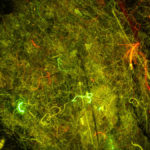
Forensic Sciences and Fluorescence with the NIGHTSEA SFA
The NIGHTSEA SFA turns your existing stereo microscope into a powerful fluorescence screening tool for evidence examination.
read more »Crack and Failure Analysis with Fluorescence
Fluorescence is a valuable tool for failure analysis, helping investigators see what they might otherwise miss. Fluorescence indicators of various types – including fluorescent penetrants, magnetic particles, and other fluorescent dyes – are commonly used to highlight cracks or defects that would otherwise be difficult or impossible to see. The fluorescence makes them stand out […]
read more »A Spectral Mystery – Solved!
We were recently contacted by a university Safety Officer (SO, from now on). A researcher using our Model SFA Stereo Microscope Fluorescence Adapter with Royal Blue excitation thought that the light source might also be emitting hazardous shortwave ultraviolet radiation. Properly concerned for general lab safety he stopped using the system until he could confirm that there was no UV hazard. […]
read more »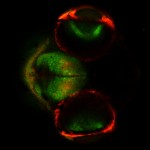
Pre-Screening Samples for Fluorescence
The NIGHTSEA Model SFA Stereo Microscope Fluorescence Adapter can turn your routine laboratory stereo microscope into a valuable tool for pre-screening your sample preparations for fluorescence before moving on to higher resolution systems.
read more »LED Safety – Microscope Adapter and Flashlights
NIGHTSEA uses light-emitting diodes (LEDs) in the fluorescence excitation light heads for the Stereo Microscope Fluorescence Adapter and in the Xite and DFP flashlights. They are focused to produce strong illumination of your subjects, but they are NOT lasers and there is no danger of instantaneous eye damage from looking directly into the light. […]
read more »Detect Calcein-Stained Fish
The NIGHTSEA Royal Blue excitation sources, combined with the appropriate barrier filters, are proven gear for detecting the green fluorescence of calcein-marked fish. We offer two primary products for this task: Xite-RB Flashlight– a simple flashlight + filter glasses combination for detection by eye Stereo Microscope Fluorescence Adapter – an economical way to use existing conventional stereo […]
read more »Fluorescence at the Seacoast Science Center
From NIGHTSEA founder Charles Mazel: On October 9, 2014, I gave a presentation on fluorescence in the sea at the Seacoast Science Center in Rye, NH. I wanted to include some local color in the presentation so I went up to the Center a couple of weeks in advance and explored fluorescence in three ways – (1) in the […]
read more »Using White Light to Focus for Fluorescence
One challenge you can run into with fluorescence photography is that the fluorescence excited by the flashlight you use to find and view subjects may not be bright enough for the camera’s autofocus system. The camera focus software likes strong edges in the image to aid in focus lock and you don’t always get those in fluorescence, whether […]
read more »Fluorescence in Pacific Coast Tide Pools
Report by Dr. Charles Mazel, NIGHTSEA founder You don’t necessarily have to go underwater to enjoy the fluorescence of marine subjects. In many places you can do fluorescence exploration when the tide goes out, providing access to subjects in tide pools and on exposed rock surfaces. On a recent trip to the Monterey peninsula (California) the timing was right for low […]
read more »