
Microplastics and Fluorescence
Microplastics in the marine and terrestrial environments, and even in the food supply, are areas of rapidly growing awareness and concern, with new publications appearing at a rapid rate. This page is intended as a resource on the role of fluorescence in research on microplastics. It is not meant to be comprehensive, but rather to highlight some of the main points and to provide an entry into the published literature. We will be updating this page periodically as new information and publications are identified. If you know of any references or other information that we should be including here, please forward that via our Contact page.
Top-level summary
- Fluorescence can be an aid in detecting microplastics within a sample, but it is not a tool for identifying the type of plastic that is found. Techniques such as Raman or FT-IR spectroscopy are needed for identification.
- Fluorescence techniques can be applied in two ways:
- Examination of unstained samples
- Examination of samples that have been stained with a fluorescent dye (usually Nile red) that binds preferentially to plastics
- For microplastic particles, staining with Nile red produces the best results. Studies (cited below) discuss factors such as preferred solvent, soaking time, recovery rate, etc.
- For microfibers derived from textiles, direct examination is likely preferred, and the use of both Ultraviolet and Royal Blue light for excitation are recommended.
- There is no fluorescence technique that will find all particles of all types of plastic. Not all plastics have inherent (non-stained) fluorescence, and not all types of plastic take up Nile red well. In some cases care must be taken to avoid false positives from organic material.
- Simple supplementary tests, such as a hot needle to check for melting, can aid in determining if material detected by fluorescence is in fact a microplastic.
- Despite the limitations, fluorescence is generally more accessible than the more advanced identification techniques and is very useful as a screening tool as part of larger research studies, or for citizen science projects to assay microplastic contamination in waterways, beaches, soils, and more.
References – Fluorescence and Microplastics
Unstained
**Dunn, C., Owens, J., Fears, L., Nunnerley, L., Kirby, J., Armstrong, O., … & Antwis, R. (2020). An affordable methodology for quantifying waterborne microplastics – an emerging contaminant in inland-waters. Journal of Limnology. doi: 10.4081/jlimnol.2019.1943 Open access
**Payton, T. G., Beckingham, B. A., & Dustan, P. (2019). Microplastic exposure to zooplankton at tidal fronts in Charleston Harbor, SC USA. Estuarine, Coastal and Shelf Science, 232. Open access
Sullivan, K. D., & Gugliada, V. (2018). Fluorescence photobleaching of microplastics: A cautionary tale. Marine pollution bulletin, 133, 622-625. Link to abstract
Nile red
Erni-Cassola, G., Gibson, M. I., Thompson, R. C., & Christie-Oleza, J. A. (2017). Lost, but found with Nile Red: a novel method for detecting and quantifying small microplastics (1 mm to 20 μm) in environmental samples. Environmental science & technology, 51(23), 13641-13648. Link to pdf
Maes, T., Jessop, R., Wellner, N., Haupt, K., & Mayes, A. G. (2017). A rapid-screening approach to detect and quantify microplastics based on fluorescent tagging with Nile Red. Scientific Reports, 7, 44501. Open access
Mason, S. A., Welch, V. G., & Neratko, J. (2018). Synthetic polymer contamination in bottled water. Frontiers in chemistry, 6, 407. Open access
Prata, J. C., Reis, V., Matos, J. T., da Costa, J. P., Duarte, A. C., & Rocha-Santos, T. (2019). A new approach for routine quantification of microplastics using Nile Red and automated software (MP-VAT). Science of The Total Environment, 690, 1277-1283. Link to abstract
Shim, W. J., Song, Y. K., Hong, S. H., & Jang, M. (2016). Identification and quantification of microplastics using Nile Red staining. Marine pollution bulletin, 113(1-2), 469-476. Link to pdf
Tamminga, M., Hengstmann, E., & Fischer, E. K. (2017). Nile red staining as a subsidiary method for microplastic quantification: a comparison of three solvents and factors influencing application reliability. SDRP J. Earth Sci. Environ. Stud., 2(2). Open access
** – used NIGHTSEA equipment to observe fluorescence
NIGHTSEA and microplastic fluorescence
A number of research groups are now using NIGHTSEA equipment, primarily the Model SFA Stereo Microscope Fluorescence Adapter, as part of their microplastics research.
We’ve received our NIGHTSEA microscope adaptor kit (Royal Blue & UV) and all I can say is WOW! What a difference they make to seeing plastic materials! I’m certainly going to apply for funds to purchase more to support our teaching and research.
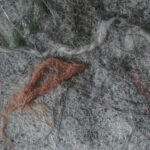
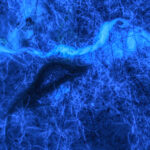
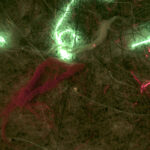
Below are white-light (left), ultraviolet-excited fluorescence (center) and blue-light-excited fluorescence (right) stereo microscope images of an assortment of fibers collected in washing machine discharge. Note that these three images are showing exactly the same area.
(Click any image for larger view)
-
- white

-
- ultraviolet

-
- blue

Pages on our web site related to microplastics and fluorescence
- Detecting microplastics
- Fluorescence of fibers and other material collected by a washing machine discharge filter
- Dryer lint fluorescence, separating white and dark loads
- An investigation of extraneous fibers found on towels and wash cloths