
NIGHTSEA and U Montana spectrUM Discovery Area – Neuroscience for young students
Application Note #3 – NIGHTSEA helps U Montana’s exciting spectrUM Discovery Area uncover the hidden world of neuroscience
Neuroscience for young students
Fluorescence provides a wonderful gateway to science in general and neuroscience in particular. Visual and easy to explain, it also contains a certain mystique: Why does blue light coming from the light source result in green light coming from the object? Why do only some things “light up” while others remain hidden in the dark? Questions like these open opportunities for discussing the physics of light as well as chemistry and biology.
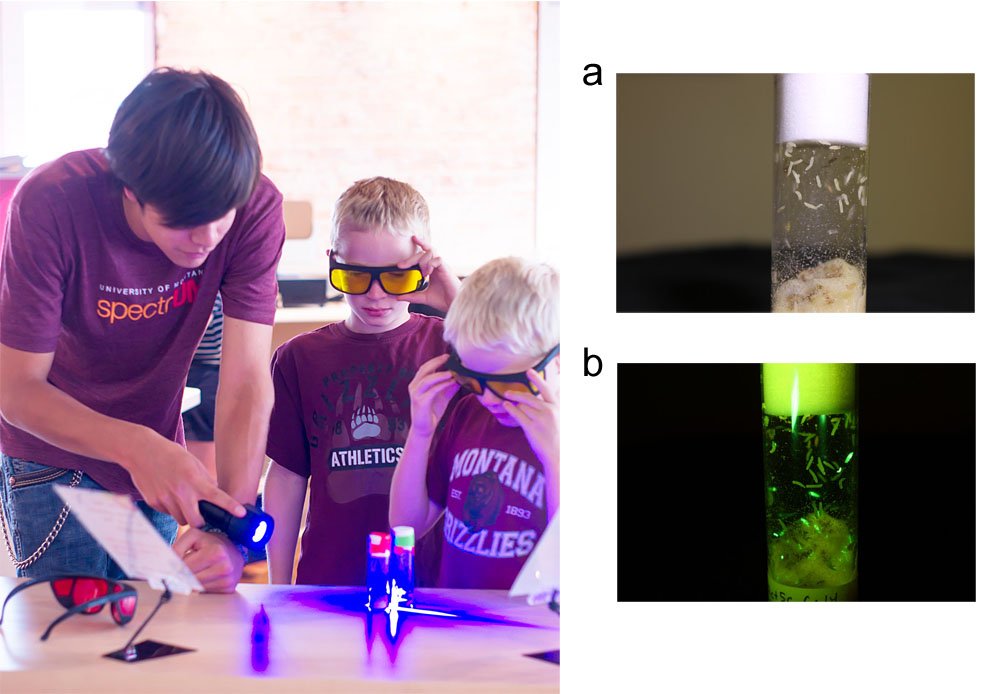
Using NIGHTSEA’s special BlueStar flashlight and goggles to investigate fruit fly larvae. (L) A simple bench top experiment. (a) Larvae viewed with regular white light (b) The BlueStar reveals that not all larvae are the same.
UM Neuroscience researcher, Sarah Certel, and the BrainZone staff have designed and implemented fluorescence demonstrations for students of all ages. A simple bench top experiment reveals a hidden world of fluorescence to kids too young to see through a microscope. Slow moving but active fruit fly (Drosophila) larvae make a great test subject. All it takes is NIGHTSEA’s “magic” BlueStar flashlight to activate the fluorescence and the matching “cool” goggles to act as barrier filters to block out ambient light to see that there is something special going on in what appeared to be a random population of wiggly critters.
See how spectrUM uses NIGHTSEA technology for neuroscience for young kids, older kids, and on the road
- spectrUM … Science … Try it!
- Neuroscience for young students
- Growing with neuroscience
- MosSE: Transforming gyms and cafeterias into powerful local learning centers
- Download the full pdf