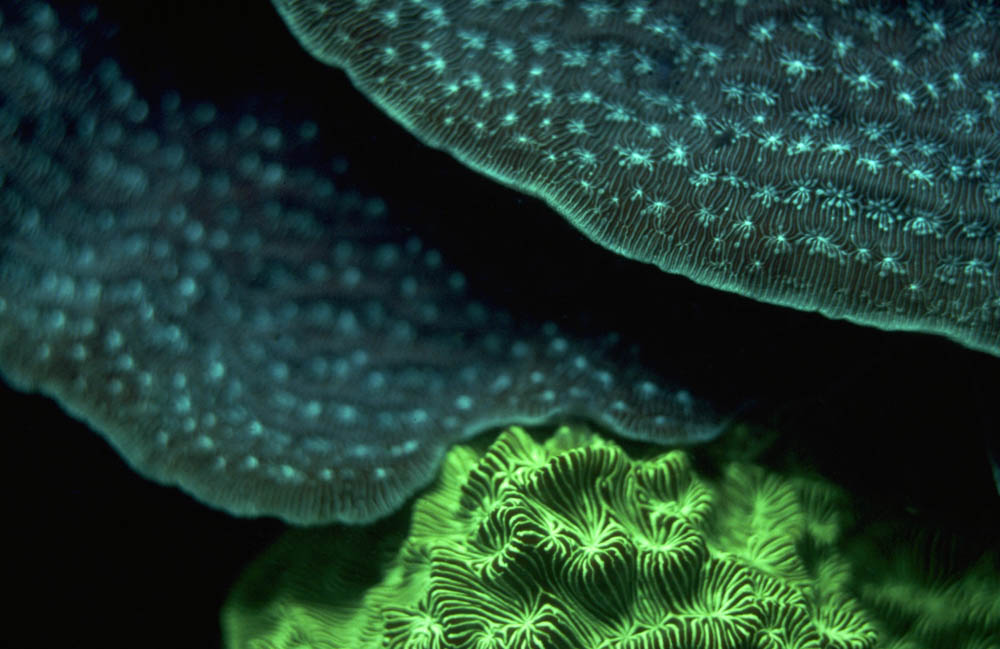

No backscatter with underwater fluorescence photography!
Posted On: Monday, April 13, 2015
A cool benefit of underwater fluorescence photography, besides the obvious one that the technique produces fantastically beautiful images, is that there is no backscatter! Backscatter is normally a major headache for underwater photographers. The light traveling from your light source bounces off particles in the water between your camera and the subject and back into your lens. The result is little bright spots throughout your photo.
But with fluorescence you are not photographing the excitation light you direct toward the subject. The only reason you send out that light is so that it will be absorbed and turned into new wavelengths (colors). You use a barrier filter to block excitation light reflected from the subject. That filter also blocks excitation reflected from particles in the water! The light emitted by the subject as fluorescence does not cause backscatter because, from the point of view of the camera, it is hitting the back side of the particles and not reaching the lens.
The white light and fluorescence photos below illustrate this nicely. The two photos were taken within about 30 seconds of each other on a windy night with lots of suspended sand particles. In the white-light image you can see lots of spots while the fluorescence shot is crystal clear.
(click for larger image)
-

- White light

-

- Fluorescence