

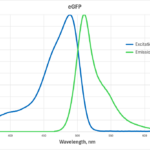
Fluorescence Excitation and Emission – Maxima vs Spectra
This article describes the relationship between fluorescence spectra vs maxima, and their role in selecting appropriate excitation and emission wavelengths.
read more »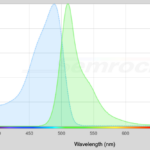
Why NIGHTSEA Offers Different Excitation Wavelengths
Why do we offer different color light sources? You need multiple options for excitation wavelengths because different materials may need different wavelengths to cause them to fluoresce.
read more »Flashing Excitation for Enhanced Detection of Fluorescence in Ambient Light
The Xite flashlights include a flashing mode that can enhance the ability to detect fluorescence in the presence of ambient light. The more contrast there is between a subject and its background, the easier it will be to detect. While fluorescence may appear bright when viewed in conditions of darkness, in actuality it […]
read more »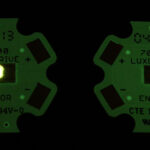
How a Remote Phosphor Works
Did you know there is no such thing as a ‘white’ LED (light-emitting diode)? Manufacturers use an added phosphor to make blue LEDs appear white. Learn more here.
read more »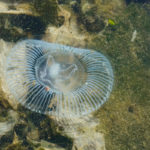
The Jellyfish that Won the Nobel Prize
The jellyfish Aequorea was the source of a discovery that led to one of the most significant advances in biological imaging ever – green fluorescent protein (GFP).
read more »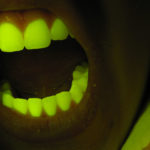
Fluorescence and Visual Function
It is tempting to think that the fluorescence of animals is there to serve a visual function, but it is more likely that in most cases it is just an incidental phenomenon. There is a lot of hard science to do to demonstrate that the fluorescence is serving a purpose.
read more »
Fluorescence and ‘Rarity’
A species is ‘rare’ in a habitat if you can find fewer of them than you can of similar organisms. Sometimes you are limited by your ability to search, and fluorescence can be a powerful tool to find otherwise hard-to-find specimens.
read more »
iBiology as a Resource for Fluorescence Techniques and More
iBiology.org is a fantastic free resource for educational videos, featuring an incredibly wide array of biological themes, principles, research topics, and ideas
read more »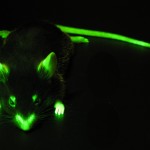
‘Glow-in-the-Dark’ vs Fluorescent
Popular articles often call things ‘glow in the dark’ that really aren’t. They are actually fluorescent, and that is a wonderful thing. Read this to understand the difference.
read more »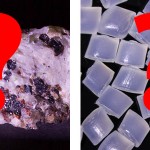
Empirical vs Scientific/First Principles Exploration of Fluorescence
There are two types of approaches to answering the question of whether something fluoresces – empirical (try it and see) vs scientific (make careful measurements). Read to learn the difference.
read more »Fluorescence Appearance can Depend on Excitation Wavelength
With fluorescence, what you see depends on how you excite and view the subject – the interaction of the excitation wavelength, the fluorescing substance, and the barrier filter.
read more »A Spectral Mystery – Solved!
We were recently contacted by a university Safety Officer (SO, from now on). A researcher using our Model SFA Stereo Microscope Fluorescence Adapter with Royal Blue excitation thought that the light source might also be emitting hazardous shortwave ultraviolet radiation. Properly concerned for general lab safety he stopped using the system until he could confirm that there was no UV hazard. […]
read more »LED Safety – Microscope Adapter and Flashlights
NIGHTSEA uses light-emitting diodes (LEDs) in the fluorescence excitation light heads for the Stereo Microscope Fluorescence Adapter and in the Xite and DFP flashlights. They are focused to produce strong illumination of your subjects, but they are NOT lasers and there is no danger of instantaneous eye damage from looking directly into the light. […]
read more »Origin of the Word Fluorescence
The term fluorescence is derived from the name of a rock. It is often the case that a physical phenomenon is observed well before it is named. For fluorescence this gap was almost 300 years. Anomalous colors of natural substances under different illuminations were noted as early as 1565. The red emission of chlorophyll extracts […]
read more »Lumens and Lights for Fluorescence – Part 2
In the previous installment we talked about what lumens are and why they are not the right rating to consider in a light for fluorescence diving and imaging. We closed by saying that the right question to ask is not ‘How bright is this light (in lumens)?’ but ‘How bright a fluorescence does this light produce in the […]
read more »Lumens and Lights for Fluorescence
How do light ratings in lumens relate to choosing lights for fluorescence? Here are a couple of questions we are asked on a regular basis: “I have a light that puts out 2000 lumens. If I put a blue filter on it will I be able to see fluorescence? What about shooting stills and video?” […]
read more »The Fluorescence Diving Experience
“Our group was so blown away by the NIGHTSEA filters that they wanted to forego the local nightlife for the rest of the week and night dive instead.” “I saw things I could not imagine.” It’s been called many things – fluodiving, fluoro diving, fluorescence night diving, UV diving – but no matter what you call […]
read more »Forms of Luminescence
Fluorescence is one of many forms of luminescence, the emission of light not resulting from heat. This distinguishes luminescence from incandescence, which is light emitted by a substance as a result of heating. All luminescence requires some input of energy to cause the light emission, and the varieties are distinguished by where that energy comes […]
read more »Physics of Fluorescence – the Jablonski Diagram
So what is really happening when something fluoresces? Electromagnetic radiation at one wavelength is absorbed and is then re-emitted at a longer wavelength. Wavelengths of light correspond to perceived colors (if they fall in the visible range), and this means that shorter wavelength light like ultraviolet or blue is converted to longer wavelength light, like green, yellow, orange, red. Before we […]
read more »Seeing Natural Fluorescence Underwater in the Daytime
When we think about underwater fluorescence we automatically think about night diving, and that is definitely the best way to see the full range and magnificence of the phenomenon. But once you get your eyes and brain tuned to it you will start to notice naturally occurring fluorescence on the reef in the daytime. Divers […]
read more »Fluorescence Diving – Dedicated Blue Light vs White Light with Filter
Should you get a dedicated blue light for fluorescence diving or use a white light with an added filter? No one solution fits all, but there are some definite trade-offs in the approaches. The 3 minute video below compares the Light & Motion Sola NIGHTSEA (blue light), the Sola 1200 with an added filter, and […]
read more »Sources of Underwater Fluorescence
Diving at night with blue light reveals a spectacular display of intense, saturated colors in a wide variety of marine plants and animals. Sometimes a subject is entirely fluorescent, and sometimes just a part. Sometimes there is just one color and sometimes a veritable rainbow. But where is the fluorescence coming from? Right now there are three […]
read more »Underwater Fluorescence FAQ
There are a number of questions that come up all the time about underwater fluorescence and the equipment needed to view and photograph it. Read on for answers to many of these questions, and please contact us to suggest other questions we should be answering! What is fluorescence? Does NIGHTSEA sell fluorescent lights? Do the […]
read more »Why NIGHTSEA uses Blue Light for Underwater Fluorescence
We use blue light for underwater fluorescence for the simple reason that it is better than ultraviolet light (black light) for this application. There is no one light that will make everything fluoresce, but if you want to choose a light to give you the most varied and vibrant fluorescence experience blue is the way […]
read more »Fluorescent Light vs. a Light that Excites Fluorescence
People often refer to lights for bringing out (exciting) fluorescence – whether for night diving or in the lab or field – as ‘fluorescent lights’. While there is no harm in that, they aren’t, and we try to be technically correct. ‘Fluorescent lights’ are what you commonly find in office buildings. They are called that because […]
read more »The Role of the Barrier Filter in Fluorescence Viewing and Photography
You need the barrier filter to block reflected excitation light and transmit only the fluorescence. Without a barrier filter you can see fluorescence from very brightly fluorescing subjects, but you would miss many, many others because the reflected excitation light can completely overwhelm the fluorescence. For best results the spectral properties of the barrier filter […]
read more »What Fluorescence Colors can you See and Photograph?
A new customer asked: “In some of your displayed pictures you have predominately green or red colors. Is this dependent upon the subject or your barrier filter? Do you need different filters to get different colors?” Great question! The barrier filter determines what colors it is possible to see, while the fluorescence properties of the […]
read more »Biological Function of Fluorescence in a Marine Organism – Mantis Shrimp
A team led by NIGHTSEA founder Charlie Mazel discovered and videotaped fluorescence in a mantis shrimp in the Bahamas in May of 2002. The discovery led to a new research project into the contribution of the fluorescence to the color pattern of the animal, and its functional role in visual ecology. The results were published in […]
read more »History of Underwater Fluorescence Observation and Photography
Fluorescence Observation The first printed record we have found of an observation of fluorescence of a marine organism dates to 1927. A Mr. C. E. S. Phillips was walking along the shore in Torbay, England, and noticed that the anemones in a tidepool seemed to be an especially bright green. He collected several specimens […]
read more »