

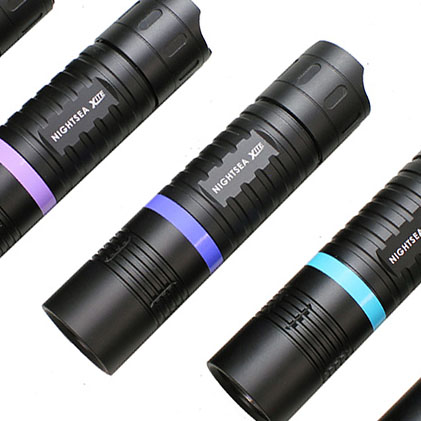
Xite Portable Fluorescence Flashlight System
Xite Portable Fluorescence Flashlight System
View fluorescence in the lab or the field! The Xite™ Fluorescence Flashlight System includes single-wavelength fluorescence excitation flashlights available with any of the five wavelengths in the NIGHTSEA line, paired with matching barrier filter glasses for maximum viewing contrast. Genotyping your transgenic organisms, screening cell cultures, inspecting parts with fluorescent penetrants, finding fluorescing critters in the field, … the Xite line provides what you need.
Video introduction to the Xite flashlights
(Click any image for larger view)
-
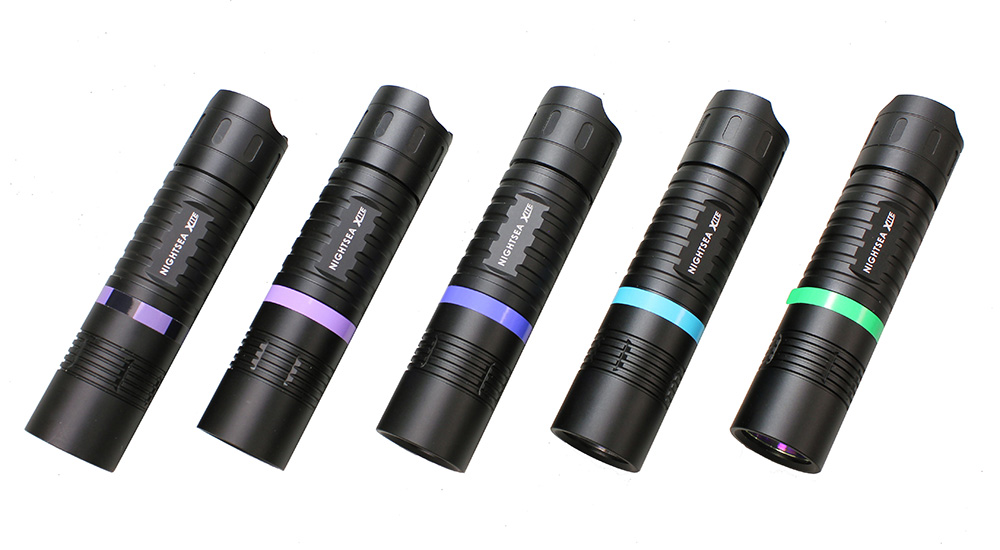
- Xite flashlights – 5 excitation wavelengths
-
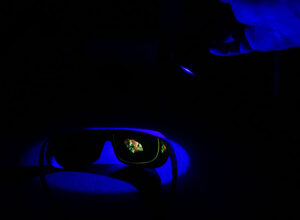
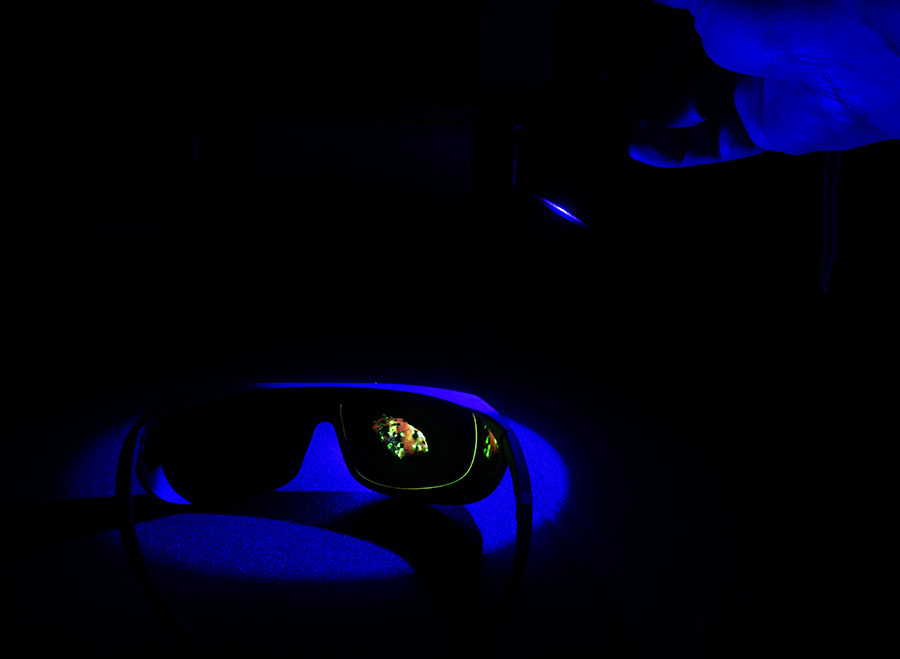
- Xite-RB and glasses with a fluorescent mineral
Avoid confusion in wavelength selection
There are two common sources of confusion in regard to selecting the best NIGHTSEA wavelength option. Please read the points below to help in selecting the right system for your application.
- Wavelength naming convention
- We name and color code our systems by the excitation wavelength (color), not the expected emission color. So if you want to observe green fluorescence such as you expect from GFP, you do not want the Green (GR) system. Our Royal Blue (RB) is the recommended wavelength set for that. Refer to articles 1 and 3 in the list directly below.
- NIGHTSEA wavelength recommendations versus excitation maxima from tables
- Many users come to NIGHTSEA armed with a desired excitation wavelength that they have found in a table of fluorescence characteristics for various fluorophores. The systems that we recommend do not always correspond to these wavelength maxima found in tables. Rather, we are often exciting on the shoulder of the excitation spectrum. Again referring to GFP, the listed excitation maximum is at 488nm, which might lead you to think our Cyan (CY) light source, which emits primarily in the 490-515nm range, is the best option. Again, our Royal Blue (RB) systems are the better choice. Refer to articles 2 and 3 in the list below. The reasons for this are explained in this article.
Relevant articles
- Naming and color coding the NIGHTSEA wavelength options
- Excitation maxima vs excitation spectra
- Table of recommended wavelength sets for various fluorophores
Features
- Tightly focused for a high intensity illumination spot
- Two power levels plus unique flashing mode
- Add-on diffuser for a broader, smoother beam
- Each light paired with matching barrier filter glasses
- Compact and lightweight
- Rechargeable high capacity lithium ion battery
- Battery level indication (when removed from flashlight and placed on charger)
Included with each system
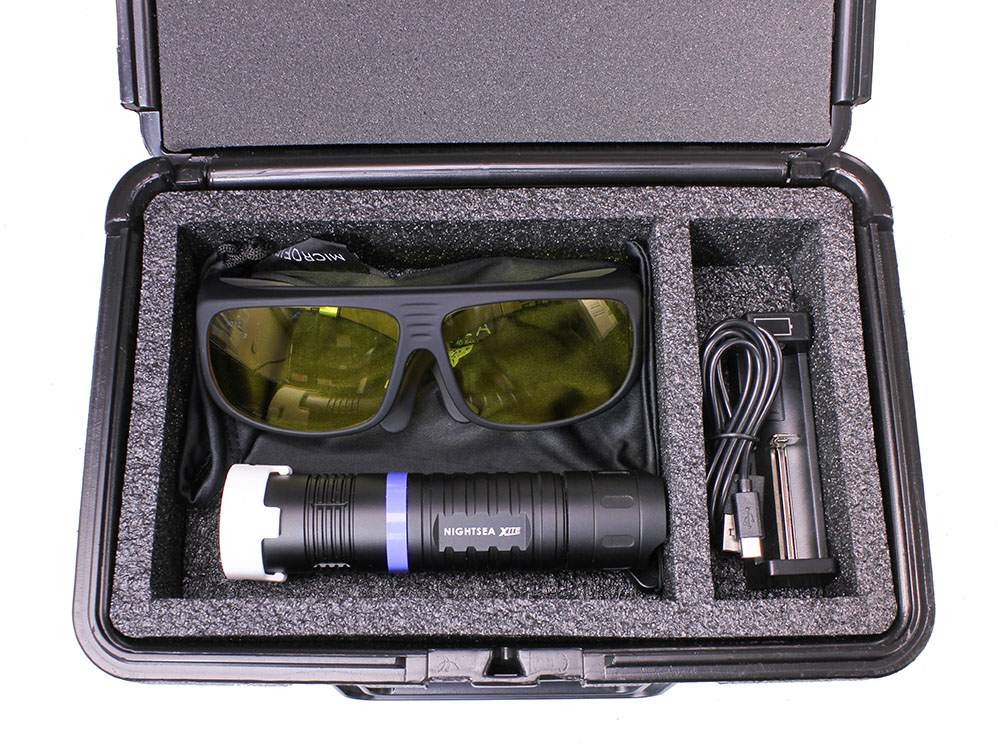
- Fluorescence excitation flashlight (your choice of one wavelength) with lanyard
- Matching barrier filter glasses with microfiber case for storage and cleaning
- Diffuser cap
- High capacity lithium ion battery
- Battery charger and USB charging cord
- Instruction sheet
- Padded foam shipping/carry/storage case
How to order
Order the Xite flashlight packages on the Electron Microscopy Sciences (EMS) web site.
For technical questions or to request a quotation – contact NIGHTSEA
Diffuser
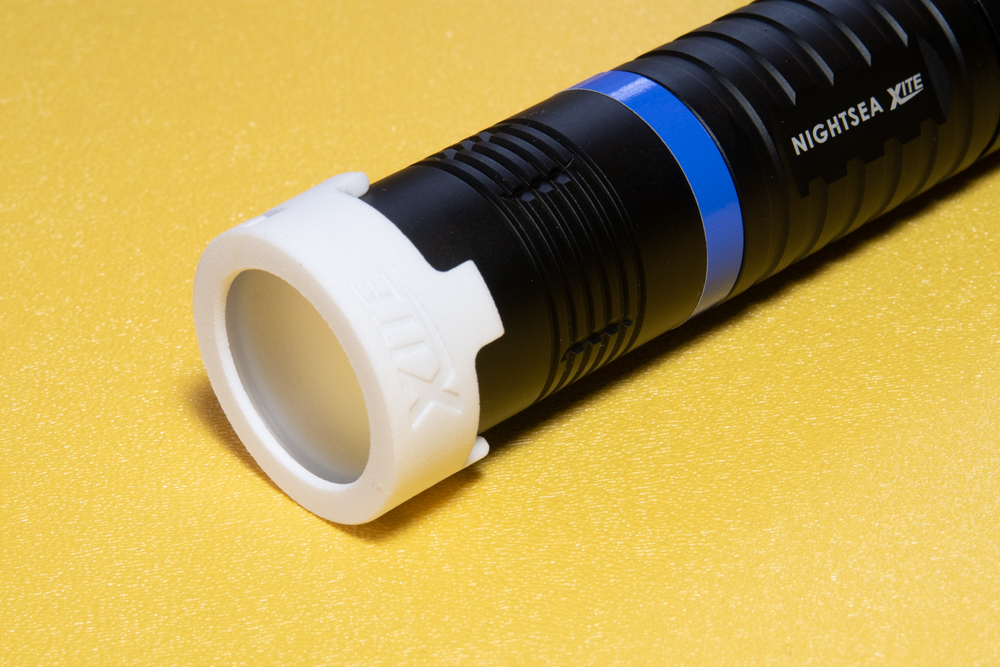
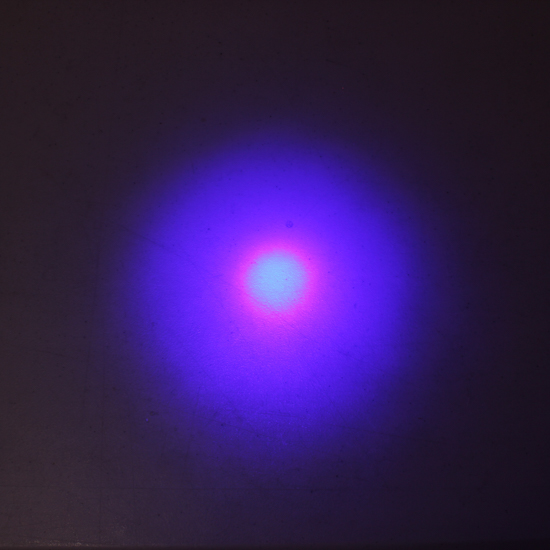
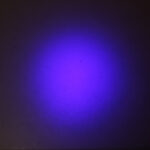
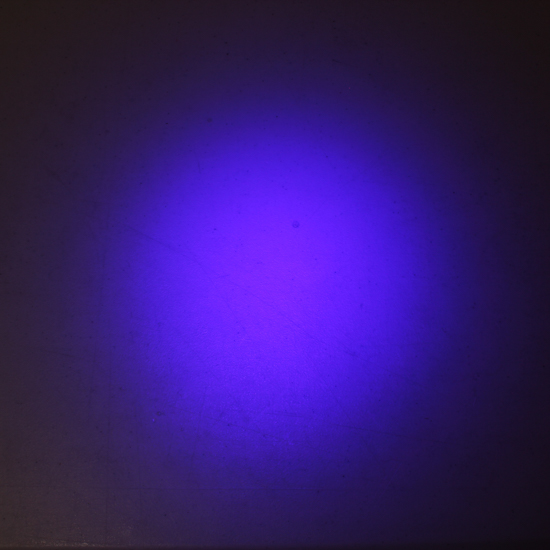
Add-on 15° diffuser cap provides a wider, softer beam
-

- Xite light with push-on diffuser
-

- Xite illumination spot, no diffuser
-
- Xite illumination spot, with diffuser
Flashing mode for enhanced detection in ambient light
As bright as fluorescence may appear when you use an intense light source to view it in conditions of darkness, in most cases it actually tends to be a relatively weak effect that is easily masked by other light. If you try to find fluorescence when there is moderate ambient light (room light, sunlight, …), any fluorescing subject will respond to the excitation, but the response may be too weak to notice easily.
But there’s a trick – by making the excitation light source blink repetitively (a strobe effect), any fluorescence will blink at the same rate, while the illuminated background will not. This flickering increases the apparent contrast and thus increases detectability.
Available wavelengths
- Wavelength sets are named and color coded for the color of the excitation light, not the color of the emitted fluorescence.
- Uncertain what to use? Refer to our comprehensive table of fluorophores and recommended NIGHTSEA wavelength sets.
- Understanding fluorescence spectra versus maxima in selecting systems.
| Designation | Excitation | Barrier Filter Glasses |
| UV – Ultraviolet | 360 – 380nm | 415nm longpass |
| VI – Violet | 400 – 415nm | 450nm longpass |
| RB – Royal Blue | 440 – 460nm | 500nm longpass |
| RB-GO – Royal Blue, Green Only | 440 – 460nm | 500 – 560nm bandpass |
| CY – Cyan | 490 – 515nm | 550nm longpass |
| GR – Green | 510 – 540nm | 600nm longpass |
- With the Royal Blue (RB) excitation we offer two options for filter glasses – longpass and bandpass. Read our article on selecting the right passband option for your application.
- Would you benefit from some basic information about fluorescence and why there are multiple excitation wavelength options? Read this article.
- There are limitations on mixing and matching the light sources and barrier filer glasses.
Camera filter recommendations
If you want to use the Xite as a light source for fluorescence photography, we have prepared recommendations for compatible off-the-shelf camera filters.

Flashlight specifications
- Dimensions – 13.5 cm long x 3.2 cm diameter (5.3 in x 1.26 in)
- Weight – 255g (9.0 oz) with battery
Note – the Xite flashlights are not suitable for underwater use
Part numbers
Wavelength sets are named and color coded for the color of the excitation light, not the color of the emitted fluorescence. Read more…
Flashlight systems
- Xite-UV – Ultraviolet (360 – 380nm) excitation
- Xite-VI – Violet (400 – 415nm) excitation
- Xite-RB – Royal Blue (440 – 460nm) excitation with longpass filter glasses
- Xite-RB-GO – Royal Blue with green-only bandpass filter glasses
- Xite-CY – Cyan (490 – 515nm) excitation
- Xite-GR – Green (510 – 540nm) excitation
Extra barrier filter glasses
- FG-UV – 415nm longpass
- FG-VI – 450nm longpass
- FG-RB-2 – 500nm longpass
- FG-RB-GO – 500 – 560nm bandpass
- FG-CY – 550nm longpass
- FG-GR – 600nm longpass
Order the Xite flashlight packages on the Electron Microscopy Sciences (EMS) web site.