
KEY Award Recipient – 2023
Posted On: Tuesday, August 29, 2023
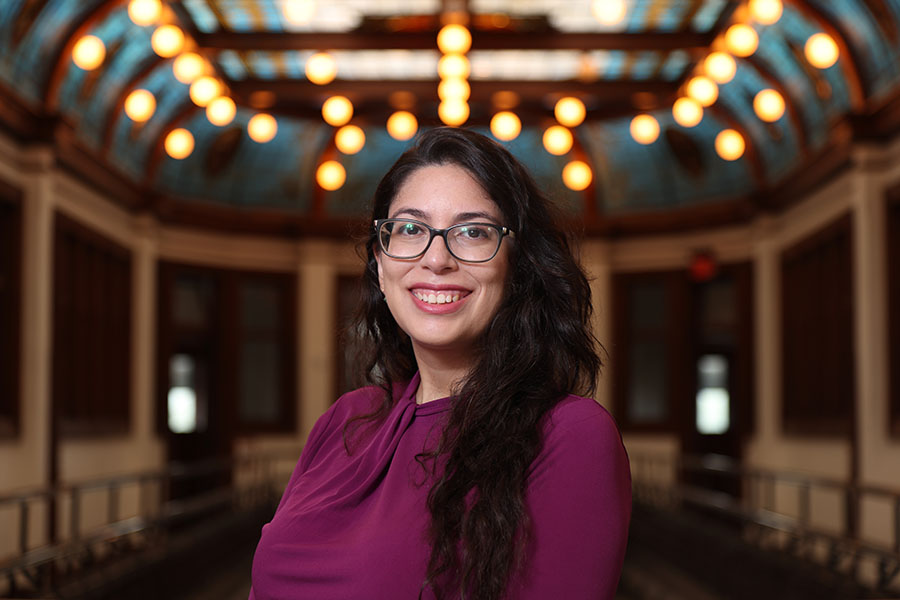
The recipient of the 2023 NIGHTSEA/EMS KEY Award for New Faculty is Dr. Andrea Suria, who is starting her new position as Assistant Professor in the Department of Biological Sciences at Ohio Wesleyan University. The KEY Award was instituted in 2015 by NIGHTSEA founder Dr. Charles Mazel to acknowledge his own mentors and as a way of giving back to the scientific community. The annual award includes a NIGHTSEA Model SFA Stereo Microscope Fluorescence Adapter system outfitted with two excitation/emission combinations plus $750 in supplies from the Electron Microscopy Sciences (EMS) catalog.
Dr. Suria earned her doctorate in Molecular and Cell Biology from the University of Connecticut and completed a combined teaching and research postdoctoral experience at the University of North Carolina at Chapel Hill. She uses eggs of the Hawaiian bobtail squid, Euprymna scolopes, and their symbiotic bacteria as a model to study beneficial host-microbe interactions. Female bobtail squid deposit beneficial bacteria in a jelly that surrounds the embryos in their eggs. The egg bacteria defend against pathogens, but the protective mechanisms are largely unknown. During her postdoc Dr. Suria developed genetic tools that allow her to create targeted or random gene mutations in the squid egg bacteria and screen for loss of the ability to kill other bacteria. She had access to a NIGHTSEA SFA system during that time and used it to visualize the outcome of bacterial competitions in colonies on petri plates. In mixed colony assays, liquid cultures of a potential killer bacterium and a fluorescently-tagged target bacterium are mixed and spotted on a petri plate. After incubating for 24 hours, she used the SFA to image the colony and determine if one strain killed the other, if they competed for space, or if they both grew together equally well. Once a killer bacterium has been found, she can generate mutants in potential antimicrobial genes and see if killing is impaired using the mixed colony assay.
This research also has broader biomedical impacts in drug discovery. Global antibiotic resistance has created a need for new antimicrobials, especially against fungal pathogens. These defensive egg bacteria are a promising new source for antimicrobials that can be developed for human application.
Dr. Suria’s teaching will bring this authentic research experience into the undergraduate biology classroom, providing students with a hands-on exploration of microbiology. As part of this process, students will also learn how to fluorescently tag bacteria. Her new NIGHTSEA system will be used as it was in her postdoc research, to visualize and document experiment outcomes. Ohio Wesleyan values community outreach, and Dr. Suria also plans to use the SFA system during the annual Summer Science Research Program to provide hands-on demos, visualizing fluorescent bacteria with members of the public.
(Click image for larger view)
Past recipients
- 2022 – Dr. Oscar Ruiz, Houston Christian University
- 2021 – Dr. Kyle Gustafson (Arkansas State University)
- 2020 – Dr. Heather Ray (Idaho State University)
- 2019 – Dr. Josh Currie (University of Toronto)
- 2018 – Dr. Pierre-Paul Bitton (Memorial University of Newfoundland)
- 2017 – Dr. Kristen Gorman (California State University Chico)
- 2016 – Dr. Sarah Petersen (Kenyon College)
- 2015 – Dr. Robert Mitchell (University of Wisconsin Oshkosh)